Piazza della Signoria - Palazzo della Signoria - Torre di Arnolfo - La Loggia dei Lanzi
Florence's Piazza della Signoria is one of the cities most well known open squares. This is also where you find the most expensive coffee, and taking any one of the pedestrianized roads that lead off the square, you can access the historical heavyweights of the Uffizi Gallery, the Ponte Vecchio or the main shopping arcade leading down to the Piazza del Duomo.
Piazza della Signoria

The Piazza as seen today is largely due to the demolition of a series of houses belonging to Ghibellini in the 13th century, by a victorious Guelfi. It was not until the 14th century that a pavement was set in the Piazza when Palazzo della Signoria (Palazzo Vecchio) was being built. The addition of Palazzo della Signoria transformed the square into the centre for political life, and this was in stark contrast to the religious activity in Piazza del Duomo, and commerce in Mercato Vecchio (now Piazza della Repubblica). In the 14th century the Loggia dell Signoria was added to the Piazza which, through the centuries, and with particular input from the Grand Dukes, has become an open air museum for visitors. The piazza was not just the centre of political life, but was also the place where public executions were held. Visitors can find a plague dedicated to Girolamo Savanarola, who was burnt alive in the piazza for heresy in the 1498, in front of Neptune's fountain.
Palazzo della Signoria

Home to Florence's local council, and made famous by films such as "Hannibal" with Anthony Hopkins (a fairly gruesome scene from Arnolfo's Tower), Palazzo Vecchio, as more commonly called by Florentine's, is without doubt a very impressive building. It was originally named "Palazzo dei Priori" but was renamed in the 15th century Palazzo della Signoria, and went on to become the priciple office of the Florentine Republic. Between 1865 and 1871 it was the official home of the Italian parliament. While today it enjoys its status of council office, there is also a museum which allows visitors to enjoy some of its wonderful interior rooms, realised by artists and architects including, Agnolo Bronzino, Giorgio Vasari an Buonattoroti and Donatello. During the period of Cosimo di Medici the Vasari Corridor was built, connecting Palazzo Vecchio with the official office at Palazzo Pitti, and passing directly over the Ponte Vecchio.
The Tower of Arnolfo
It's an icon to the city, the Tower of Arnolfo (Torre di Arnolfo) was constructed in 1310 when the main body of Palazzo della Signoria was almost finished. At 94 metres tall, the tower is not in the centre of the Palace, but slightly to the right, (when seen from the main piazza). This is because the tower was in fact perched on previous dwelling, from which the bell found in the tower today, was taken. The main body of the tower was used for imprisonment,most famously Cosimo the Old, upon his return from exile in 1433. The large clock the tower displays was originally constructed by the Florentine, Nicolò Bernardo, but was changed in 1667 for another designed by Giorgio Ledele di Augusta.
La Loggia dei Lanzi
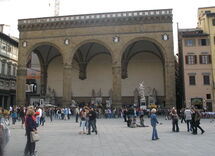
Constructed between 1376 and 1382 it has served as the place to welcome and greet popular public figures, and perform public ceremonies in front of the local crowds. The Loggia is Gothic in style yet the arches are prophetic in form, looking towards the Renaissance period. These arches were probably the inspiration for Filippo Brunelleschi's very first renaissance building, the Innocenti Hospital in Piazza Santissima Annunziata. From 1500, and with the creation of the Granducato of Tuscany, and the final suppression of the republican institutions, the Loggia become an open air art gallery where sculptures and "Capo Lavori" (master works) went on public display (it is said to be one of the first open-air galleries in the World). The Loggia is unique to this day because it houses incredible sculptures such as Perseus (Benvenuto Cellini) and Centaur Nessus (Giambologna) without any restrictions on access. Due to this, a 24-hour guard is maintained by the Comune to protect the integrity of this unique building.