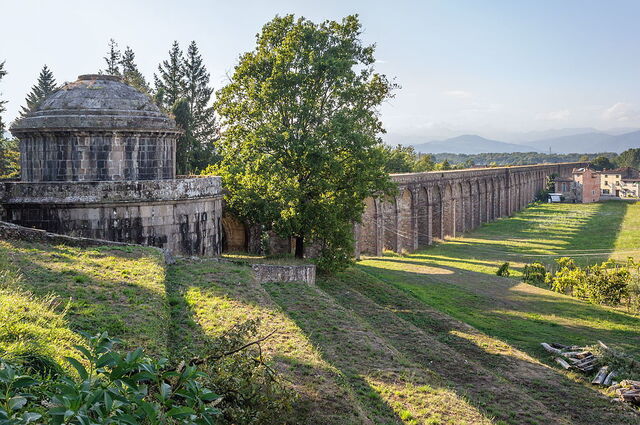
When you visit the city of Lucca in Tuscany, you would be forgiven for misidentifying one of the landmarks in town. An impressive aqueduct, the Acquedotto Del Nottolini, is located just outside of the city and plenty of visitors originally think that it is contemporaneous to many of the other Ancient Roman structures which dot the landscape of Italy. However, it is actually much more modern than that. This neoclassical gem was built for practical reasons and modelled after those older examples but actually dates to the 19th century. Find a luxury villa in Lucca and visit this stunning work of civic architecture for yourself!
It became apparent that it was a necessity to equip Lucca with an aqueduct to supply water of good quality and solve the hygiene issues plaguing the city in the early 18th century.
Lengthy discussions between planners, scientists and engineers, however, lead to a long delay in any projects being started. It wasn't until the 19th century that any progress was actually made.
Royal architect, Lorenzo Nottolini was appointed head of the project and work began in 1823. Delays came again and after several interruptions, it was finally completed in 1851.
The water was directed from several springs on the northern slope of Mount Pisano where it passed through several layers of stones and gravel to become pure and clear.
Lengthy discussions between planners, scientists and engineers, however, lead to a long delay in any projects being started. It wasn't until the 19th century that any progress was actually made.
Royal architect, Lorenzo Nottolini was appointed head of the project and work began in 1823. Delays came again and after several interruptions, it was finally completed in 1851.
The water was directed from several springs on the northern slope of Mount Pisano where it passed through several layers of stones and gravel to become pure and clear.
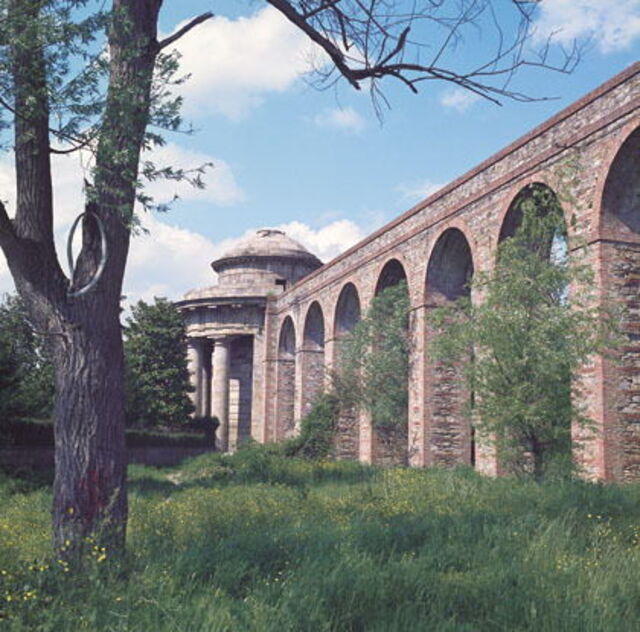
It was collected in the little temple-cistern of San Concordio, a lovely, circular-plan building in the neoclassical style. Inside, is a large marble basin divided into two tunnels containing very large smelted iron tubes which channelled water into the conduit that passed over a row of more than 400 arches in brick and masonry for a length of about 3250 metres, before arriving underground into town and ending at the large fountain in the square beside the cathedral.
A large part of the aqueduct is still visible today in the parkland of the Monumental Aqueduct of Guamo, all of it rendered in that elegant neoclassical style.
Paths through the park offer walks along lengths of the aqueduct, though parts have been interrupted by modern building such as the motorway outside of Lucca. However, these strolls, despite not offering the unspoiled views of the structure of the past, are still pleasant and allow you to view one of the prettiest works of civic architecture in all of Tuscany.
A large part of the aqueduct is still visible today in the parkland of the Monumental Aqueduct of Guamo, all of it rendered in that elegant neoclassical style.
Paths through the park offer walks along lengths of the aqueduct, though parts have been interrupted by modern building such as the motorway outside of Lucca. However, these strolls, despite not offering the unspoiled views of the structure of the past, are still pleasant and allow you to view one of the prettiest works of civic architecture in all of Tuscany.
Photo credits
picture 1: Myrabella / CC BY-SA 3.0;
picture 3: Myrabella / CC BY-SA 3.0
picture 1: Myrabella / CC BY-SA 3.0;
picture 3: Myrabella / CC BY-SA 3.0