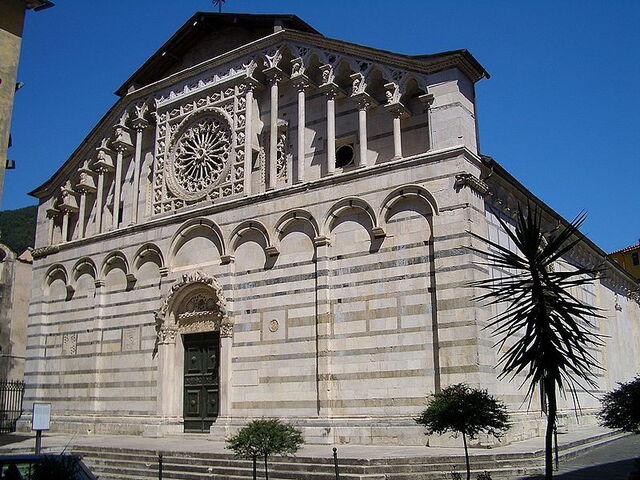
Carrara is a Tuscan town that is famous worldwide for its marble and is the centre of the Apuan-Versilia marble trade.
Since Roman times, it has been where artists and architects from the world over have gone to source their marble, the likes of Michelangelo among them. Situated along the Ligurian Sea, in north-western Tuscany, it is a charming town that features the material it is so famous for in buildings throughout. A particular highlight is the Cathedral, or Duomo: with almost the entire exterior being covered in Carrara marble, it really is a perfect advertisement for the town's “white gold”.
Another, older church, once stood on the same site. The Ecclesia Sancti Andree de Carraria has records going back as early as 1035 but only a bas-relief remains of the original structure. Construction of the new building, also dedicated to St Andrew, began in the 11th century and was completed in the 14th century.
Since Roman times, it has been where artists and architects from the world over have gone to source their marble, the likes of Michelangelo among them. Situated along the Ligurian Sea, in north-western Tuscany, it is a charming town that features the material it is so famous for in buildings throughout. A particular highlight is the Cathedral, or Duomo: with almost the entire exterior being covered in Carrara marble, it really is a perfect advertisement for the town's “white gold”.
Another, older church, once stood on the same site. The Ecclesia Sancti Andree de Carraria has records going back as early as 1035 but only a bas-relief remains of the original structure. Construction of the new building, also dedicated to St Andrew, began in the 11th century and was completed in the 14th century.
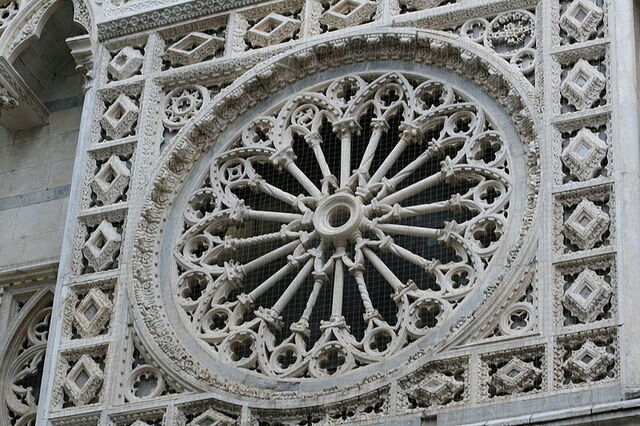
Built on a rectangular Romanesque plan with a semicircular apse, the building combines Pisan Gothic and Lucchese architectural styles. The interior is not particularly well-preserved with only fragments of frescoes remaining yet the stripped back interior with only the sculptural ornamentation remaining has a certain charm of its own.
The largely bare interior features a lovely, highly ornamental pulpit to the left of the nave, the sarcophagus of St. Ceccardus, patron saint of Carrara, a 14th-century "Annunciation" sculpture, and a 14th-century wooden crucifix by Angelo Puccinelli.
The columns of the nave have capitals with both Corinthian and Composite orders and the mullioned windows feature sculptural designs with leaves and human and animal motifs.
The largely bare interior features a lovely, highly ornamental pulpit to the left of the nave, the sarcophagus of St. Ceccardus, patron saint of Carrara, a 14th-century "Annunciation" sculpture, and a 14th-century wooden crucifix by Angelo Puccinelli.
The columns of the nave have capitals with both Corinthian and Composite orders and the mullioned windows feature sculptural designs with leaves and human and animal motifs.
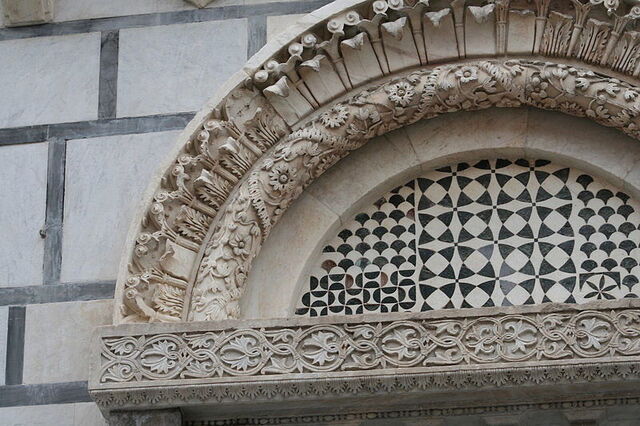
The facade, meanwhile, is a little more worthy of writing home about. Nearly entirely clad in that beautiful white marble, the lower section of the façade and the side area near the St. John Portal are characterized by a bichrome decoration with geometrical marble tarsias in pale and darker marble. A Gothic rose window and bell tower complete the building perfectly and in front of the building is Baccio Bandinelli's "Statua del Gigante" (Statue of the Giant).
This charming church is an example of how to use the local expertise in marble and makes it obvious why the material enamoured so many. Just find a vacation rental in Massa Carrara province and visit this building and learn all about the town's famous stone.
This charming church is an example of how to use the local expertise in marble and makes it obvious why the material enamoured so many. Just find a vacation rental in Massa Carrara province and visit this building and learn all about the town's famous stone.
Photo credits
picture 1: Vmenkov / CC BY-SA 3.0;
picture 2: Alessandrotozzi56 / CC BY-SA 3.0;
picture 3: Alessandrotozzi56 / CC BY-SA 3.0
picture 1: Vmenkov / CC BY-SA 3.0;
picture 2: Alessandrotozzi56 / CC BY-SA 3.0;
picture 3: Alessandrotozzi56 / CC BY-SA 3.0