Tuscany is home to imposing forts, impossibly pretty medieval hilltop towns, dreamy country villas, staggering cathedrals, architectural curiosities, and much more besides. It is a place where centuries of wealth and artistic innovation resulted in a architectural language, landscape, and heritage that is matched by few other places in the world. If you're an enthusiast or if you're simply just a casual observer, then you're likely to find yourself impressed and often lost for words at the incredible buildings that you will encounter while travelling in Tuscany. While travel is yet a good way off for most of us, we can dream and look ahead to a time in which it is possible once more. And, in the meantime, we can take a look at just five of the most unique architectural gems in Tuscany and start adding the ones that most take our fancy to bucket lists that are, no doubt, growing by the day in this time of social-distancing. Here are our picks of just five of the most incredible architectural feats that you can find in Tuscany, as we see it:
1. Cappella Della Madonna Vitaleta
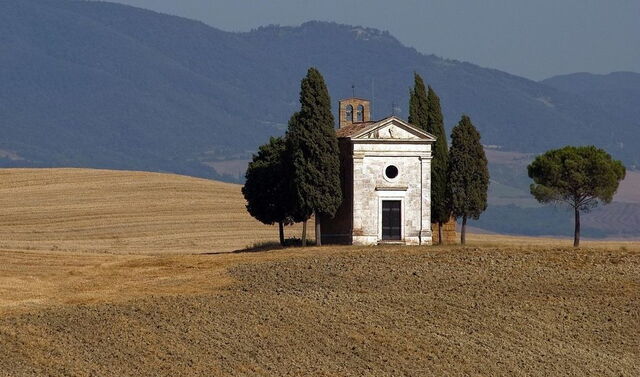
Nestled among the iconic winding roads and perfect rolling hills of the Val D’Orcia the Chapel of the Madonna di Vitaleta, or La Cappella della Madonna Vitaleta, emerges like an image too picturesque, too symmetrical, too perfect for real life. This evocative scene has been the subject of endless photographs and postcards and for good reason, it is like an image plucked from the pages of a story book and is an example of a building and setting coexisting in perfect harmony.
1. Cappella Della Madonna Vitaleta
Nestled among the iconic winding roads and perfect rolling hills of the Val D’Orcia the Chapel of the Madonna di Vitaleta, or La Cappella della Madonna Vitaleta, emerges like an image too picturesque, too symmetrical, too perfect for real life. This evocative scene has been the subject of endless photographs and postcards and for good reason, it is like an image plucked from the pages of a story book and is an example of a building and setting coexisting in perfect harmony.
Built during the 12th century on the spot where legend says that the Virgin Mary appeared to a shepherdess, the chapel was the property of the Hospital of Santa Maria della Scala in Siena. It is first noted in a written document in 1590 and was famous for its sculpture of the Madonna by the renowned artist, Andrea della Robbia, until it was moved to the Church of Madonna di Vitaleta in nearby San Quirico. The elegant neoclassical façade with its little rose window is a more recent intervention that can be attributed to restorations in 1884 under Giuseppe Partini and the whole building, compact and lovely as it is, looks immensely charming, like a dollhouse, that is perfectly at home in the equally picture-perfect setting of the rolling hills of the Val D'Orcia. Framed prettily by cypresses either side, it is no wonder that it has been declared a World Heritage Site by UNESCO and draws tourists and professional photographers from the world over to photography it in all sorts of conditions.
2. Piazza Dell'Anfiteatro
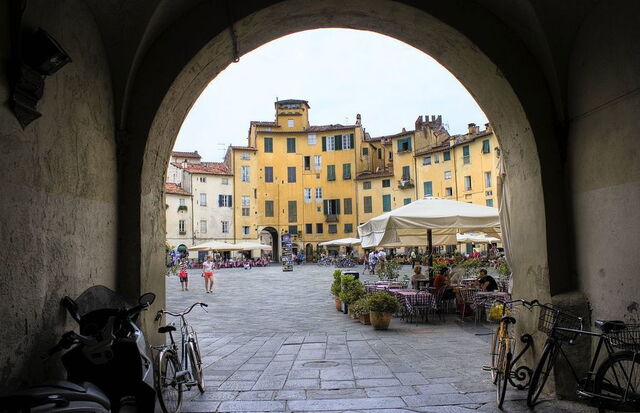
While there are endless beautiful piazzas all over Tuscany and Italy, the pretty walled town of Lucca is home to a rather especially charming example, the Piazza dell'Anfiteatro or, Amphitheatre Square. Named for the remains of a Roman amphitheatre dating back to the 2nd century on which it was built, it first became a public square in the Middle Ages and has since been altered and added to throughout the centuries, notably in the 19th century under architect Lorenzo Nottolini, who was commissioned to rebuild the piazza and to evoke the roman ruins of the amphitheatre over which it was built. Opened and enlarged into a giant elliptical shape, this pretty space has long since been a natural gathering point for locals as a market square and home to cafes and restaurants. It is the perfect place to grab a coffee, sit back, and admire the distinct and lovely architectural character of Tuscany.
2. Piazza Dell'Anfiteatro
While there are endless beautiful piazzas all over Tuscany and Italy, the pretty walled town of Lucca is home to a rather especially charming example, the Piazza dell'Anfiteatro or, Amphitheatre Square. Named for the remains of a Roman amphitheatre dating back to the 2nd century on which it was built, it first became a public square in the Middle Ages and has since been altered and added to throughout the centuries, notably in the 19th century under architect Lorenzo Nottolini, who was commissioned to rebuild the piazza and to evoke the roman ruins of the amphitheatre over which it was built. Opened and enlarged into a giant elliptical shape, this pretty space has long since been a natural gathering point for locals as a market square and home to cafes and restaurants. It is the perfect place to grab a coffee, sit back, and admire the distinct and lovely architectural character of Tuscany.
3. Castello Di Brolio
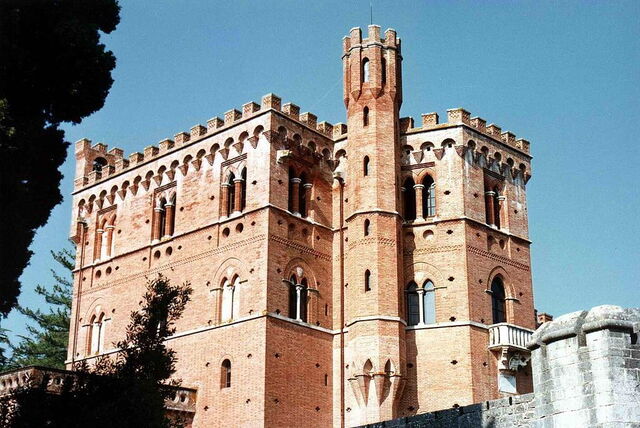
Castello di Brolio is one of the prettiest castles in Tuscany and, while it is steeped in stories of ghosts and hauntings, it looks like something from a fairytale. Emerging distinctive and lovely, from the lush surroundings of the southern Chianti countryside, it is located on top of an isolated hill a few kilometers from Gaiole and commands incredible views over the surrounding area. A strategic outpost for Florence for centuries, it was destroyed and rebuilt on several occasions. Property of the Ricasoli family since 1141, the current appearance can be attributed to one Bettino Ricasoli under whom the castle was given its incredibly picturesque and pretty Gothic Revival makeover in the 19th century. The lovely red brick exterior, mouldings around the openings, and turrets are further enhanced by the charming Renaissance gardens with typical geometric shaped bushes and the English woods that surround the property and the amazing panoramic views over the Chianti region afforded by its raised position. Even better, the castle is part of a huge Chianti Classico-producing estate and the oldest winery in Italy, so why not come, sample the wares, and enjoy the architectural splendour and stunning surrounding views with an excellent glass of wine in hand?
Castello di Brolio is one of the prettiest castles in Tuscany and, while it is steeped in stories of ghosts and hauntings, it looks like something from a fairytale. Emerging distinctive and lovely, from the lush surroundings of the southern Chianti countryside, it is located on top of an isolated hill a few kilometers from Gaiole and commands incredible views over the surrounding area. A strategic outpost for Florence for centuries, it was destroyed and rebuilt on several occasions. Property of the Ricasoli family since 1141, the current appearance can be attributed to one Bettino Ricasoli under whom the castle was given its incredibly picturesque and pretty Gothic Revival makeover in the 19th century. The lovely red brick exterior, mouldings around the openings, and turrets are further enhanced by the charming Renaissance gardens with typical geometric shaped bushes and the English woods that surround the property and the amazing panoramic views over the Chianti region afforded by its raised position. Even better, the castle is part of a huge Chianti Classico-producing estate and the oldest winery in Italy, so why not come, sample the wares, and enjoy the architectural splendour and stunning surrounding views with an excellent glass of wine in hand?

4. Palazzo Rucellai
During the Renaissance, the architecture of ancient Rome and Greece was reappropriated and used in new ways with varying degrees of accuracy and loyalty by the leading architects of the time. One of the staunchest supporters was Alberti, a key architect from the period who was famous for his buildings and his treatise, “On Architecture”, which became an important manual and inspiration for others. One of the best examples of his work is the Palazzo Rucellai, in the historic centre of Florence. Built for the Rucellai family, one of the great families of Florence who had made their fortune through their trade as wool merchants, the palace references the Medici's palace and shows loyalty to Florence's leading family through this. It also displays the taste and education of the Rucellai through the use of geometry, proportion, and classical elements informed by Alberti's study of the Antique. One of the finest examples of domestic Renaissance architecture in Florence and, probably, the world, it is one pit stop to pencil in and admire if you ever find yourself exploring the city.
During the Renaissance, the architecture of ancient Rome and Greece was reappropriated and used in new ways with varying degrees of accuracy and loyalty by the leading architects of the time. One of the staunchest supporters was Alberti, a key architect from the period who was famous for his buildings and his treatise, “On Architecture”, which became an important manual and inspiration for others. One of the best examples of his work is the Palazzo Rucellai, in the historic centre of Florence. Built for the Rucellai family, one of the great families of Florence who had made their fortune through their trade as wool merchants, the palace references the Medici's palace and shows loyalty to Florence's leading family through this. It also displays the taste and education of the Rucellai through the use of geometry, proportion, and classical elements informed by Alberti's study of the Antique. One of the finest examples of domestic Renaissance architecture in Florence and, probably, the world, it is one pit stop to pencil in and admire if you ever find yourself exploring the city.
5. Villa Masini
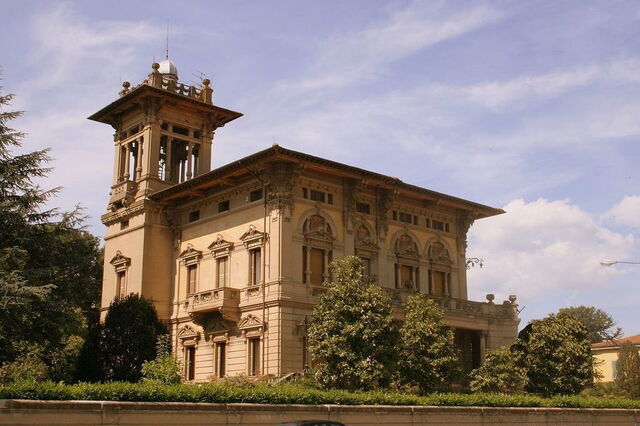
Located in Montevarchi in Tuscany, Villa Masini was built by the entrepreneur Angiolo Masini and designed by local engineer Giuseppe Petrini. Work began in 1924, with Masini not scrimping on anything as he wanted to build a perfect family home for himself and his beloved wife; seeking out the most talented painters, glass-makers, and textile artists and the finest stone, marble, furniture, and fittings to outfit their house. Finished in 1927, by which time Mrs Masini had sadly already passed away, it is a masterpiece of Art Nouveau and Art Deco design and was even chosen to feature in Roberto Benigni’s Oscar-winning "La Vita è Bella". Often where concerts are held, this impossibly pretty villa and its stunning gardens make for an utterly idyllic place in which to listen to live music on a warm summer's evening in Tuscany while getting lost in the architectural and cinematic perfection of your surroundings.
So, if you're fond of an architectural feature or simply like looking at pretty settings, these architectural gems are sure to delight the senses! Be sure to keep your eyes peeled as you explore Tuscany and to always look up as you never know what kind of truly wonderful surprises and what kinds of stunning buildings that just you might see if you do.
Located in Montevarchi in Tuscany, Villa Masini was built by the entrepreneur Angiolo Masini and designed by local engineer Giuseppe Petrini. Work began in 1924, with Masini not scrimping on anything as he wanted to build a perfect family home for himself and his beloved wife; seeking out the most talented painters, glass-makers, and textile artists and the finest stone, marble, furniture, and fittings to outfit their house. Finished in 1927, by which time Mrs Masini had sadly already passed away, it is a masterpiece of Art Nouveau and Art Deco design and was even chosen to feature in Roberto Benigni’s Oscar-winning "La Vita è Bella". Often where concerts are held, this impossibly pretty villa and its stunning gardens make for an utterly idyllic place in which to listen to live music on a warm summer's evening in Tuscany while getting lost in the architectural and cinematic perfection of your surroundings.
So, if you're fond of an architectural feature or simply like looking at pretty settings, these architectural gems are sure to delight the senses! Be sure to keep your eyes peeled as you explore Tuscany and to always look up as you never know what kind of truly wonderful surprises and what kinds of stunning buildings that just you might see if you do.
Photo credits
Picture 1: Vignaccia76 / CC BY-SA 3.0;
Picture 2: Graeme Maclean / CC BY 2.0;
Picture 4: Giorgiomantoan / CC BY-SA 3.0;
Picture 5: Emiliano Burzagli / CC BY-SA 3.0
Picture 1: Vignaccia76 / CC BY-SA 3.0;
Picture 2: Graeme Maclean / CC BY 2.0;
Picture 4: Giorgiomantoan / CC BY-SA 3.0;
Picture 5: Emiliano Burzagli / CC BY-SA 3.0