Archive for 'Churches & Religious Buildings'


Florence Cathedral
In the final post in this series, here are the last of Google's suggestions for what to do with just a day in Florence. Having just left the Piazza della Signoria, we now move on to the Duomo.

7. Florence Cathedral (Travel: 10 minutes by foot. Approx. time to spend here: 1 hour)

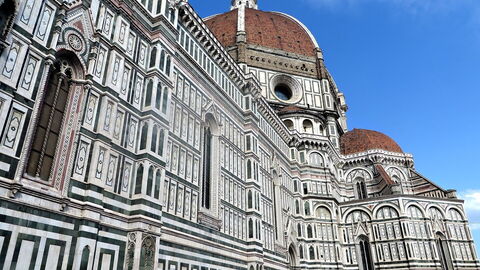
The Basilica di Santa Maria del Fiore, or the Duomo, is Florence's cathedral and main church. It was begun in 1296, according to the designs of Arnolfo di Cambio, and was completed in 1436 with the addition of a soaring dome engineered by Filippo Brunelleschi.

The exterior is expressed in polychromatic marble panels and an elaborate 19th century Gothic Revival façade by Emilio De Fabris. A UNESCO World Heritage Site, it is one of the city's must-see attractions and the view from the top is unrivaled.     Read More


Santa Croce
Continuing on from our last post, we are still following along Google's automatically generated itinerary for a day in Florence. Having just crossed the Ponte alle Grazie, a quieter bridge over the Arno, just a stone's throw from the busier and more famous Ponte Vecchio, we were on our way to the next attraction…

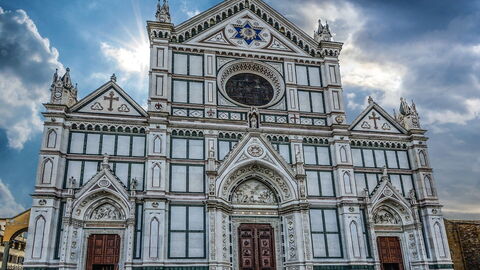
4. Santa Croce (Travel: Less than 5 minutes by foot. Approx. time to spend here: 1 hour)

This stunning Gothic church is a lovely polychromatic 13th century Franciscan basilica that is the final resting place of the likes of Michelangelo, Galileo and Machiavelli among others. Packed to the rafters with incredible frescoes, stained glass, sculptures and other objets d'art, there is plenty to see and do. In fact, there is too much to take it all in entirely in a single visit but the experience of stepping inside this jewel box of culture and history is worth the minor sensory overload.     Read More


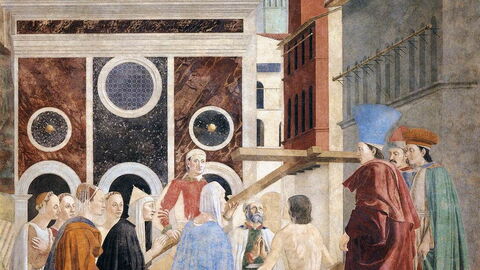
A segment of the True Cross frescoes
The Cappella Bacci is a chapel located in the apse of 14th-century Basilica di San Francesco, a single-nave building in Arezzo dedicated to St Francis and built reflecting the values typical of the mendicant orders of the day.

Work was begun in the second half of the thirteenth century and completed in the fourteenth, with a campanile added in the sixteenth century. Both exterior and interior are somewhat grave and austere, though the interior is a richer and less intensely pared back place.

The exterior is expressed with a roughly textured stone facade without any real ornamentation, while the interior is accented with niches containing fourteenth-century and Renaissance ornamentation and Gothic chapels.

One among these chapels is particularly famous: the Bacci Chapel, and the reason for its recognition and fame? It is home to a cycle of incredible frescoes by the famous Renaissance painter Piero della Francesca. Just find a luxury villa in Arezzo and drop by to see it for yourself.     Read More


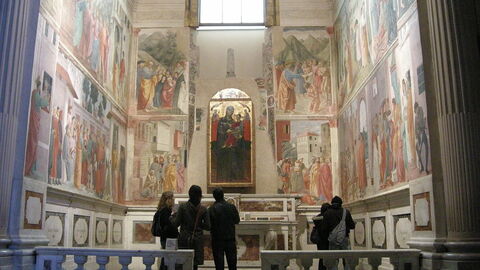
Brancacci Chapel
The Brancacci Chapel is one of the chapels within the Church of Santa Maria del Carmine in Florence. In fact, it is the shining jewel of the building as much was lost in an 18th century fire, leaving the church otherwise very plain.

Miraculously, this great artwork survived and is even often referred to as the “Sistine Chapel of the Early Renaissance” due the wonderful frescoes that adorn its walls. Just find a luxury villa near Florence and you can discover these extraordinary paintings for yourself!

In 1424, frescoes were commissioned by Felice Brancacci, a wealthy Florentine merchant and statesman, to decorate the chapel and to illustrate the life of St. Peter. They were designed by Masolino da Panicale and he was aided in their production by his pupil, Masaccio. Masaccio then took over in 1428 but, sadly, passed away that very year at just 27 years of age.     Read More


St Francis by Cigoli
Saint Francis of Assisi is one of the most famous and well-known Italian saints. His story is perfectly formed to capture hearts and imaginations: the son of a rich mercantile family, he lived the life of a playboy and was a soldier but, after a being held in captivity as a prisoner of war for a year, he had a big change of heart and renounced his way of life entirely. He dedicated himself to a life of piety and charity and founded the Franciscan order, which is based on poverty and alms.     Read More