The tradition of the Palio dates back to medieval times, when most of the communities throughout Italy would have a local athletic competition between the contrades, or districts, of the town. Less populated areas would have the hamlets of a commune compete against one another. The traditions were typically a commemoration of an event that varied from town to town, some had jousts, archery tournaments, horse races, and even bull fights right in the city. Other cities have changed the traditions to slightly safer contests, much like Montepulciano's Bravio delle Botti.
Today, the Palio di Siena is the most well known event of its kind in Italy, so well known in fact, that it is usually referred to as simply "the Palio".
There are seventeen contrade in Siena, but only ten contrade compete in the race, The seven that did not compete in the previous Palio are automatically in the race, along with three others chosen at random.
The horses are chosen by the representatives from each contrade three days before the race and after the ten best horses are chosen, a lottery is then held to see which contrade will get which horse.
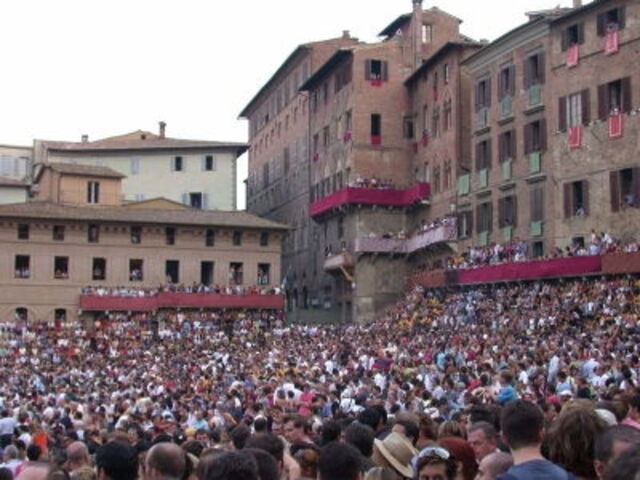
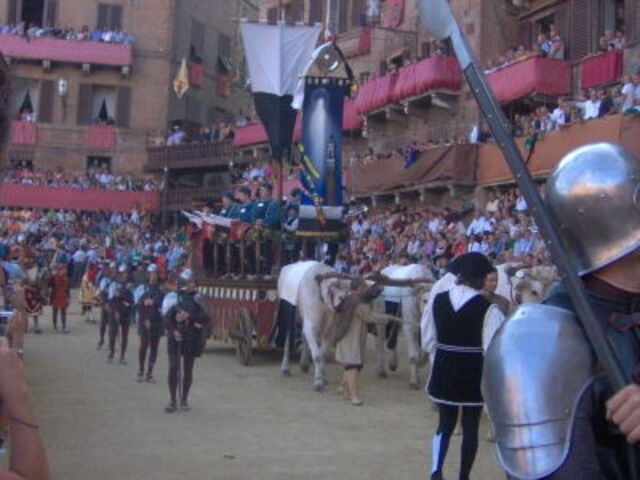
The Piazza del Campo is prepared for the race several days ahead of time. A dirt track is created around the edges, with mattresses used for padding in one particularly nasty turn. The piazza is surprisingly fit for this use, as it is built in an enormous shell shape. If you've ever visited Siena during any other point, its hard to imagine the beautiful central piazza of the city packed full of people; the sides, center of the track, each story of the buildings and rooftops will soon be standing room only.Preceding the actual race is an elaborate parade with a group of horsemen in medieval garb demonstrating a war charge. Each contrade parades their horse, jockey, and representatives with their coat of arms around the piazza. City officials ride through on horseback carrying the flag of Siena, trumpeters and other V.I.P.s bring up the end on a chariot. The parade is quite a sight to see, with the bright and colorful medieval costumes and pageantry that has been a tradition for hundreds of years.
There are seventeen contrade in Siena, but only ten contrade compete in the race, The seven that did not compete in the previous Palio are automatically in the race, along with three others chosen at random.
The horses are chosen by the representatives from each contrade three days before the race and after the ten best horses are chosen, a lottery is then held to see which contrade will get which horse.
The Piazza del Campo is prepared for the race several days ahead of time. A dirt track is created around the edges, with mattresses used for padding in one particularly nasty turn. The piazza is surprisingly fit for this use, as it is built in an enormous shell shape. If you've ever visited Siena during any other point, its hard to imagine the beautiful central piazza of the city packed full of people; the sides, center of the track, each story of the buildings and rooftops will soon be standing room only.Preceding the actual race is an elaborate parade with a group of horsemen in medieval garb demonstrating a war charge. Each contrade parades their horse, jockey, and representatives with their coat of arms around the piazza. City officials ride through on horseback carrying the flag of Siena, trumpeters and other V.I.P.s bring up the end on a chariot. The parade is quite a sight to see, with the bright and colorful medieval costumes and pageantry that has been a tradition for hundreds of years.
The race is called to start by a blast in the piazza, and the horses break out of the starting position and charge around the track in a frantic scramble. A horse can still win the Palio even without his jockey, should he be dismounted. The winner is of course first one past the finish line, but there is no second, third or fourth 'place' as in most horse races: the horse in second place is considered the loser of the race.
If you are lucky enough to be visiting Tuscany during the Palio, it is definitely an experience you will not find in many other places on earth.
If you are lucky enough to be visiting Tuscany during the Palio, it is definitely an experience you will not find in many other places on earth.