Florence is the Renaissance capital and a city stuffed to the gills with history, culture and, in particular, art. There are endless works of art to see and stumble upon in the streets, palaces, churches, public buildings and the many excellent museums and galleries around the city. One of the best of these museums has to be the Galleria dell'Accademia, which, amongst other things, is home to Michelangelo's exceptionally famous “David”.
The incredible Accademia adjoins the academy of Fine Arts of Florence and was founded in 1784 by the Grand Duke of Tuscany at the time, Pietro Leopoldo. It is also home to wonderful works of art by many other famous artists besides Michelangelo, such as Sandro Botticelli, Domenico Ghirlandaio, Paolo Uccello and endless other artists and Renaissance Masters, in particular.
Just find a luxury villa in Florence and discover the masterpieces within for yourself!
The incredible Accademia adjoins the academy of Fine Arts of Florence and was founded in 1784 by the Grand Duke of Tuscany at the time, Pietro Leopoldo. It is also home to wonderful works of art by many other famous artists besides Michelangelo, such as Sandro Botticelli, Domenico Ghirlandaio, Paolo Uccello and endless other artists and Renaissance Masters, in particular.
Just find a luxury villa in Florence and discover the masterpieces within for yourself!
To help you get started, we have compiled a list of some of the key works you should make time to track down when you visit. Here are some of the must-see pieces in the Accademia.
1. David, Michelangelo, 1501-1504
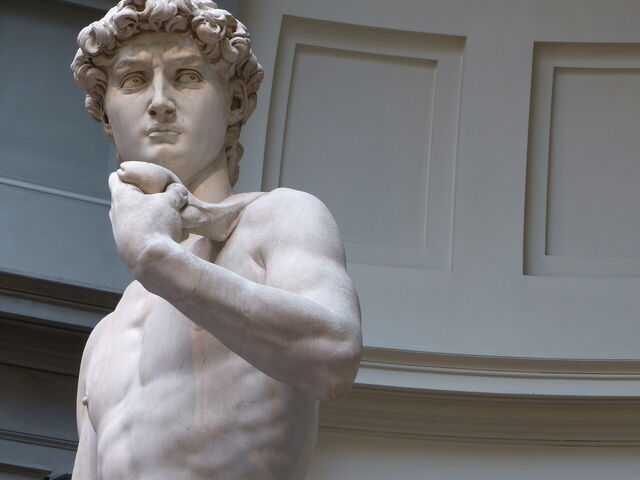
While there are other works to see, it would be remiss of us not to mention Michelangelo's “David”. Undoubtedly the museum's most famous work, this 17ft marble statue of a standing male nude is probably one of the single most iconic sculptures in the history of art. The figure in question is the Biblical hero, David and was originally commissioned as one of a series of statues of prophets to be positioned along the roofline of city's Duomo. However, upon completion, the difficulties of getting it onto the roof became apparent and it was placed outside the Palazzo della Signoria in the Piazza della Signoria, instead. Since then, it has been moved indoors (to protect the priceless work of art from damage or theft) into the Accademia and a reproduction stands in its place.
1. David, Michelangelo, 1501-1504
While there are other works to see, it would be remiss of us not to mention Michelangelo's “David”. Undoubtedly the museum's most famous work, this 17ft marble statue of a standing male nude is probably one of the single most iconic sculptures in the history of art. The figure in question is the Biblical hero, David and was originally commissioned as one of a series of statues of prophets to be positioned along the roofline of city's Duomo. However, upon completion, the difficulties of getting it onto the roof became apparent and it was placed outside the Palazzo della Signoria in the Piazza della Signoria, instead. Since then, it has been moved indoors (to protect the priceless work of art from damage or theft) into the Accademia and a reproduction stands in its place.
Interestingly, unlike the earlier and many depictions of this popular topic, Michelangelo's David is shown tense and ready before the battle and all references to Goliath are absent, such as the head of the giant upon which Donatello stands. He is shown as a youthful and beautiful ideal male, something which Michelangelo was adept at and interested in producing.
2. Venus and Cupid, Pontormo after Michelangelo, c.1533
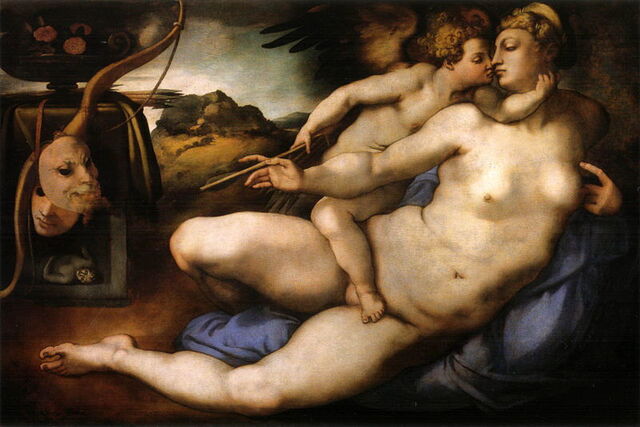
This work, meanwhile, is not by Michelangelo's own hand but is after one of his lost works. The actual artist is the Florentine Jacopo da Pontormo was and early exponent of Italian Mannerism who worked for important patrons such as the Medici, Borgherini and others. Da Vinci, Michelangelo and Durer all influenced his work and, thankfully, that interest has preserved images that would have been otherwise lost to history, such as this image after Michelangelo. A little disturbing to look at – largely as Venus is so massive and has somewhat odd proportions – it showcases the fact that while Michelangelo mastered the ideal male form, his female figures were always a little strange. Venus is depicted turning her massive body to kiss her young son and the subject, too, lends an uncomfortable note to the image for modern eyes.
For more important works and must-see pieces in the Accademia, be sure to read on to the next posts in this series.
2. Venus and Cupid, Pontormo after Michelangelo, c.1533
This work, meanwhile, is not by Michelangelo's own hand but is after one of his lost works. The actual artist is the Florentine Jacopo da Pontormo was and early exponent of Italian Mannerism who worked for important patrons such as the Medici, Borgherini and others. Da Vinci, Michelangelo and Durer all influenced his work and, thankfully, that interest has preserved images that would have been otherwise lost to history, such as this image after Michelangelo. A little disturbing to look at – largely as Venus is so massive and has somewhat odd proportions – it showcases the fact that while Michelangelo mastered the ideal male form, his female figures were always a little strange. Venus is depicted turning her massive body to kiss her young son and the subject, too, lends an uncomfortable note to the image for modern eyes.
For more important works and must-see pieces in the Accademia, be sure to read on to the next posts in this series.