The Galleria dell'Accademia is one of Florence's most exceptional museums and is most famous as the home of Michelangelo's “David”. While the museum is home to works by other Renaissance Masters such as Sandro Botticelli, Domenico Ghirlandaio and Paolo Uccello and while there is more to see beyond the “David”, the gallery is especially interesting to fans of Michelangelo as it has works by, after and in progress by the artist. Just find a luxury villa in Florence and discover the masterpieces within for yourself! This next work in our pick of must-sees in the gallery, also has a Michelangelo connection.
5. Palestrina Pietà, Unknown, c.1555
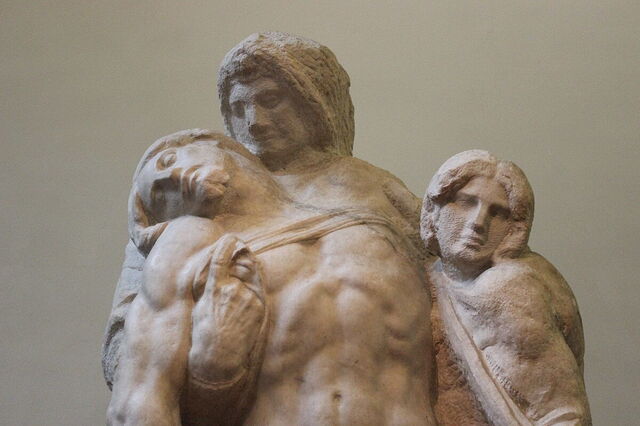
The Palestrina Pietà is a marble sculpture made around c. 1555, dating to a period that is known as the Italian High Renaissance. Formerly attributed to Michelangelo, it is now almost universally accepted that it must have been completed by someone else, such as Niccolò Menghini or Gian Lorenzo Bernini.
5. Palestrina Pietà, Unknown, c.1555
The Palestrina Pietà is a marble sculpture made around c. 1555, dating to a period that is known as the Italian High Renaissance. Formerly attributed to Michelangelo, it is now almost universally accepted that it must have been completed by someone else, such as Niccolò Menghini or Gian Lorenzo Bernini.
Today the most popular attribution is to a “Follower of Michelangelo”. Famous artists often had large schools of students who worked or studied directly under the artist in question in a studio, helping to produce commissioned works by completing minor parts of paintings and sculptures and leaving the Master to finish finer details such as hands, faces etc. Followers were also artists who may not have studied directly under an artist but who copied their works extensively while learning and who were influenced greatly stylistically by the Master. A controversial work, it is interesting from the point of view of older methods of learning as an artist and ideas about originality that differ quite drastically to those held today.
This Pietà scene depicts three figures, one of which is the body of Jesus Christ, and was originally in a room beside the Santa Rosalia church in Palestrina before being acquired by the government in 1939 and ending up in the Accademia. Attribution to Michelangelo only dates to the 18th century and is not recorded earlier, further adding to the controversial nature of this claim. No matter who the artist is, however, this remains an intriguing work of art.
This Pietà scene depicts three figures, one of which is the body of Jesus Christ, and was originally in a room beside the Santa Rosalia church in Palestrina before being acquired by the government in 1939 and ending up in the Accademia. Attribution to Michelangelo only dates to the 18th century and is not recorded earlier, further adding to the controversial nature of this claim. No matter who the artist is, however, this remains an intriguing work of art.
6. The Virgin and Child with Two Angels and the Young St John the Baptist, Botticelli, c.1470
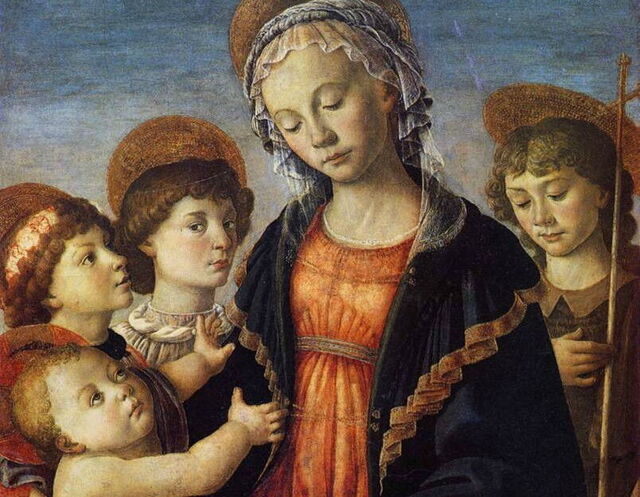
The Accademia is also home to several works by the famous Early Renaissance artist Sandro Botticelli. None are iconic or well-known works but they are still in his beautiful, lyrical style and incredibly interesting. In fact, this picture of the Virgin by Botticelli is among the earliest of all of his known paintings and reveals the great influence of the images of the Virgin by Fra Filippo Lippi, his teacher. Mary is shown holding her child on her knees and supported by an angel. Another angel and the young Baptist flank the central figures. The rich gold, ornate fabrics and sweet figures are all characteristic of the artist's background and tastes. A pretty painting, it gives great insight into the master that Botticelli would one day become.
Be sure to read on to the last post in this series for some more picks of works to see in the Accademia.
The Accademia is also home to several works by the famous Early Renaissance artist Sandro Botticelli. None are iconic or well-known works but they are still in his beautiful, lyrical style and incredibly interesting. In fact, this picture of the Virgin by Botticelli is among the earliest of all of his known paintings and reveals the great influence of the images of the Virgin by Fra Filippo Lippi, his teacher. Mary is shown holding her child on her knees and supported by an angel. Another angel and the young Baptist flank the central figures. The rich gold, ornate fabrics and sweet figures are all characteristic of the artist's background and tastes. A pretty painting, it gives great insight into the master that Botticelli would one day become.
Be sure to read on to the last post in this series for some more picks of works to see in the Accademia.
Photo credits
Picture 1: Miguel Hermoso Cuesta / CC BY-SA 4.0
Picture 1: Miguel Hermoso Cuesta / CC BY-SA 4.0