Table settings
Posted in: Countryside Food and Wine Localities Restaurants & Cafés
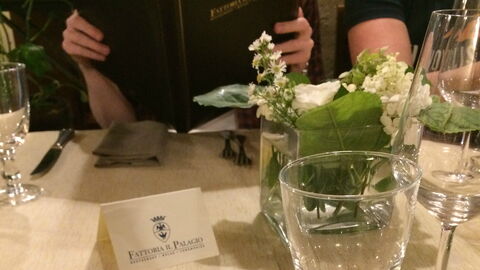
I'll admit something right off the bat: I like Italian food but I don't love it enough to eat it every day. So, when I recently spent a week in Tuscany, I quickly became tired of similar menus. Fattoria Il Palagio did not have a wildly different menu and, yet, it was the best dining experience that I had in Tuscany, by far.

Located just outside of Scarperia, a small and charming historic town in the northeast of Tuscany, around 25km from Florence, and famous for the production of knives, the restaurant immediately impresses upon first approaching it.

It is an old villa, sitting on beautifully maintained grounds and with excellent views of the surrounding landscape to the rear of the property. The building is surrounded by plant-draped pergolas and twinkling lights that make it atmospheric after nightfall and it is hard to decide if it is lovelier at night or during the day.
Vineryard
Posted in: Day Trips Florence Food and Wine Localities Tourist Attractions Wineries & Breweries
When my family decided that they wanted to visit a winery the very next day, late in the afternoon, I spent a rather panicked evening researching somewhere that suited their rather demanding stipulations and would be able to take us on such short notice.

I eventually (after much hair pulling and cursing under my breath) found Agriturismo Frascole and saw they did daily tours and tastings and were about a half hour drive from our villa. I rang early the next morning and they were able to take us at 3, as I requested. Little did I know how fortuitously excellent a selection it would prove to have been.

The road up to the winery was not easy. However, Frascole is located near the charming town of Dicomano, high up in Tuscan Apennines in the middle of an unspoiled area of natural beauty. The historic buildings, surrounding fields of the vineyard and incredible views over the mountains and valleys below were truly breathtaking.
Berlingozzo
Posted in: Food and Wine Recipes
If you have always wanted to visit Tuscany, one of the most fun and interesting times of year to go is during the celebrations of Carnevale. Carnevale, or Carnival, is that famous last lavish festive period that marks the beginning of the fasting period Lent in the run up to Easter. One of the most indulgent days is Martedì Grasso, also known more commonly as the French Mardi Gras. This “Fat Tuesday” is a day to stuff your face and one of Tuscany's favoured traditional treats is Berlingozzo, a simple ring-cake originally from Lamporecchio, in the province of Pistoia. Dating back to the time of the Medici, it is actually a rather humble, plain cake rooted in local peasant cuisine and was traditionally eaten on the Thursday before Easter (called ‘Berlingaccio’), which closed the carnival celebrations. It pairs perfectly with local wines such as Vin Santo or a creamy cappuccino for a sweet breakfast.
Pappa al Pomodoro
Posted in: Food and Wine Recipes
Pappa al Pomodoro is one of those quintessentially Tuscan dishes, though it may be your first time hearing of it! Funnily enough, tomatoes were only introduced to Italy from the New World relatively recently and, yet, they made an incredible impact on European cuisine and Tuscan food, in particular. Now many of the most Tuscan dishes that one can think of, feature tomatoes: whether this be a newly created dish or one that was centuries old already, before the addition of tomatoes!

Pappa al Pomodoro is one of the most traditional Tuscan soups and is easy to make, healthy and (most importantly) tasty! The key is getting the best, freshest ingredients possible and some really great (but stale) bread (ideally unsalted, Tuscan-style bread) to accompany it.
Crostata di Marmellata
Posted in: Florence Food and Wine Localities Recipes
A crostata is an Italian baked tart or pie and they can be traced back to at least the 15th century in their modern form. It is characterised by being a "rustic free-form version of an open fruit tart". Traditionally, a crostata consists of a base of three layers of friable dough but, today, shortcrust pastry is used instead. It is differentiated from a torta by its filling, as a crostata has an inconsistent chunky filling, whereas a torta has a consistent filling made of ingredients that have been blended together.