Archive for 'Chianti'


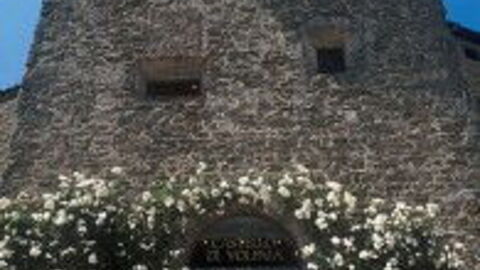
Pieve di Barberino
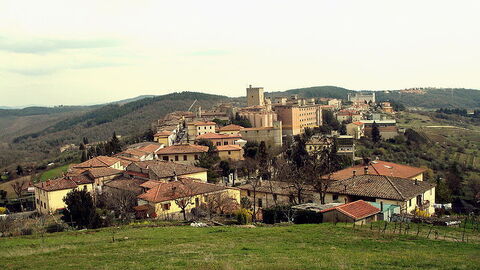
There are many reasons to visit the small town of Barberino Val d'Elsa, which is located in the vicinity of the larger city of Florence in Tuscany.

Not only is it a prime example of medieval architecture that retains its original walled fortifications, but it also is home to many important works of art, exquisite chapels, and other sights to visit.

You can learn more about the history of the famous Barberini family, who have their origins here in this exciting municipality. The town is named after the valley of the Elsa, which surrounds it in lush splendor.

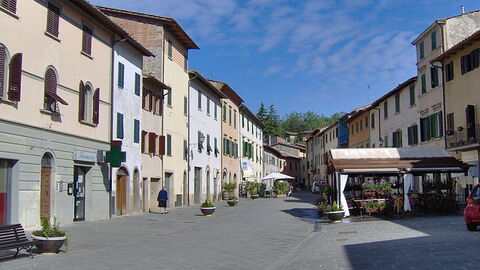
Within town, you'll find many things to see in Barberino Val d'Elsa. This includes the Church of San Bartolomeo, for example, which has fragments of a painting by the famous Giotto, as well as a bronze bust crafted by the artist Pietro Tacca. By following the Via Francesco da Barberino, you will work your way through the well-manicured streets up to the Sienese Gate, or Porta Senese, which dates back to 1365. Those interested in learning more about the area's ancient past can visit the Antiquarium Museum, which holds Etruscan artifacts found in the different necropolises scattered throughout the area. If you have seen the famous Cupola in Florence, you may want to take a look at the Chapel of San Michele Arcangelo, which has a perfect reproduction.     Read More


Fiasco
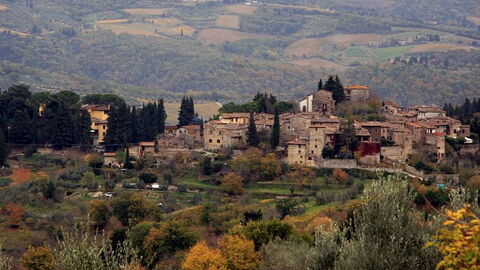
The Chianti region does not have clearly distinguishable boundaries based on morfological, geographical or climatic criteria. The only unifying element of the region is the production of a high quality red wine since the 12th century. The name, which comes from the Etruscan "Clante-i", was mentioned for the first time in documents from the 8th century in defining the territories of the ancient Lega (League), the administrative district that included the current communities of Radda, Gaiole and Castellina. 

In 1932 the Chianti wine area was completely re-drawn and divided in seven sub-areas: Classico, Colli Aretini, Colli Fiorentini, Colline Pisane, Colli Senesi, Montalbano and Rùfina. Most of the villages that in 1932 were suddenly included in the new Chianti Classico area added in Chianti to their name-such as Greve in Chianti which amended its name in 1972. Wines labeled Chianti Classico come from the biggest sub-area of Chianti, that sub-area that includes the old Chianti area.

The other variants, with the exception of Rufina from the north-east side of Florence and Montalbano in the south of Pistoia, originate in the respective named provinces: Siena for the Colli Senesi, Florence for the Colli Fiorentini, Arezzo for the Colli Aretini and Pisa for the Colline Pisane. In 1996 part of the Colli Fiorentini sub-area was renamed Montespertoli.     Read More