The Chianti region does not have clearly distinguishable boundaries based on morfological, geographical or climatic criteria. The only unifying element of the region is the production of a high quality red wine since the 12th century. The name, which comes from the Etruscan "Clante-i", was mentioned for the first time in documents from the 8th century in defining the territories of the ancient Lega (League), the administrative district that included the current communities of Radda, Gaiole and Castellina.
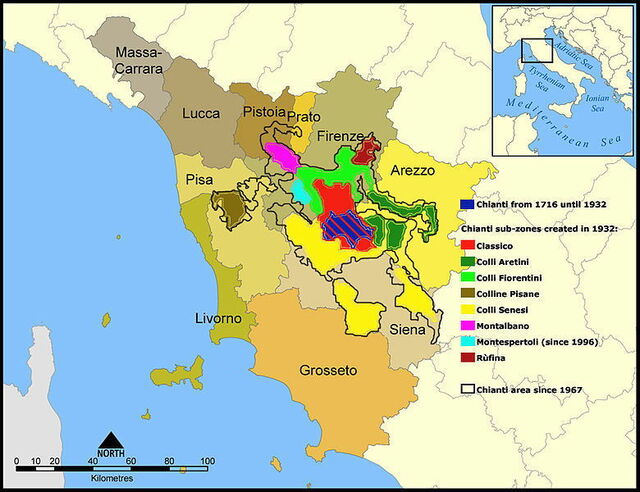
In 1932 the Chianti wine area was completely re-drawn and divided in seven sub-areas: Classico, Colli Aretini, Colli Fiorentini, Colline Pisane, Colli Senesi, Montalbano and Rùfina. Most of the villages that in 1932 were suddenly included in the new Chianti Classico area added in Chianti to their name-such as Greve in Chianti which amended its name in 1972. Wines labeled Chianti Classico come from the biggest sub-area of Chianti, that sub-area that includes the old Chianti area.
The other variants, with the exception of Rufina from the north-east side of Florence and Montalbano in the south of Pistoia, originate in the respective named provinces: Siena for the Colli Senesi, Florence for the Colli Fiorentini, Arezzo for the Colli Aretini and Pisa for the Colline Pisane. In 1996 part of the Colli Fiorentini sub-area was renamed Montespertoli.
In 1932 the Chianti wine area was completely re-drawn and divided in seven sub-areas: Classico, Colli Aretini, Colli Fiorentini, Colline Pisane, Colli Senesi, Montalbano and Rùfina. Most of the villages that in 1932 were suddenly included in the new Chianti Classico area added in Chianti to their name-such as Greve in Chianti which amended its name in 1972. Wines labeled Chianti Classico come from the biggest sub-area of Chianti, that sub-area that includes the old Chianti area.
The other variants, with the exception of Rufina from the north-east side of Florence and Montalbano in the south of Pistoia, originate in the respective named provinces: Siena for the Colli Senesi, Florence for the Colli Fiorentini, Arezzo for the Colli Aretini and Pisa for the Colline Pisane. In 1996 part of the Colli Fiorentini sub-area was renamed Montespertoli.
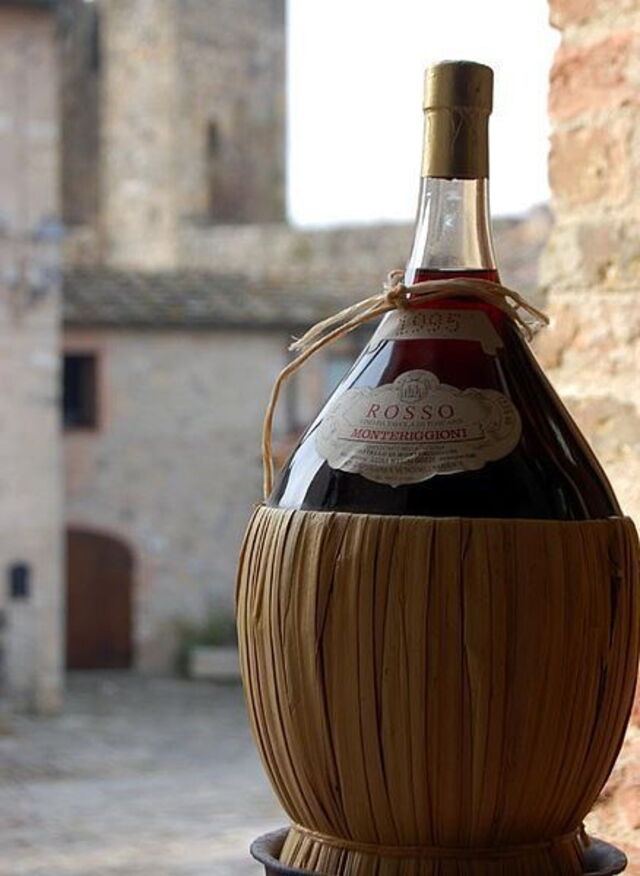
This wine was historically associated with a squat bottle enclosed in a straw basket, called a fiasco ("flask"); however, the fiasco is only used by a few makers of the wine now; most Chianti is bottled in traditionally shaped wine bottles.
Baron Bettino Ricasoli (later Prime Minister in the Kingdom of Italy) created the Chianti recipe of 70% Sangiovese, 15% Canaiolo and 15% Malvasia bianca in the middle of the nineteenth century. During the 1970s producers started to reduce the quantity of white grapes in Chianti. In 1995 it became legal to produce a Chianti with 100% Sangiovese. For a wine to retain the name of Chianti, it must be produced with at least 80% Sangiovese grapes.
A Chianti may have a picture of a black rooster (known in Italian as a gallo nero) on the neck of the bottle, which indicates that the producer of the wine is a member of the Gallo Nero Consortium, an association of producers of the Classico sub-area sharing marketing costs. Aged Chianti (38 months instead of 4-7), may be labelled as Riserva. Chianti that meets more stringent requirements (lower yield, higher alcohol content and dry extract) may be labelled as Chianti Superiore, although Chianti from the "Classico" sub-area is not allowed in any event to be labelled as "Superiore".
If you'd like to stay in villa in Chianti, please browse these rentals, Chianti villa rentals.
Oh, and not to forget, free wine tasting for EasyReserve customers !
Baron Bettino Ricasoli (later Prime Minister in the Kingdom of Italy) created the Chianti recipe of 70% Sangiovese, 15% Canaiolo and 15% Malvasia bianca in the middle of the nineteenth century. During the 1970s producers started to reduce the quantity of white grapes in Chianti. In 1995 it became legal to produce a Chianti with 100% Sangiovese. For a wine to retain the name of Chianti, it must be produced with at least 80% Sangiovese grapes.
A Chianti may have a picture of a black rooster (known in Italian as a gallo nero) on the neck of the bottle, which indicates that the producer of the wine is a member of the Gallo Nero Consortium, an association of producers of the Classico sub-area sharing marketing costs. Aged Chianti (38 months instead of 4-7), may be labelled as Riserva. Chianti that meets more stringent requirements (lower yield, higher alcohol content and dry extract) may be labelled as Chianti Superiore, although Chianti from the "Classico" sub-area is not allowed in any event to be labelled as "Superiore".
If you'd like to stay in villa in Chianti, please browse these rentals, Chianti villa rentals.
Oh, and not to forget, free wine tasting for EasyReserve customers !